Wedding Invitation Name Order Calculator
Determine Name Order for Your Wedding Invitation
Enter your wedding details and get the correct name order based on modern etiquette.
Your Invitation Text
Your invitation text will appear here after calculation.
Tips: Modern invitations often use alphabetical order or equal partnership. Include both names clearly without outdated phrases like "daughter of" or "son of".
When you’re sitting at your kitchen table, staring at a blank wedding invitation, the first question that stops you isn’t about font or color-it’s this: whose name goes first?
It’s a tiny detail, but it carries weight. Get it wrong, and someone’s grandma might raise an eyebrow. Get it right, and it sets the tone for the whole event. The answer isn’t as simple as "bride first" anymore. Times have changed, and so have the rules.
Traditional Rules: Bride First, Always
For decades, the standard was simple: the bride’s name came first. It came from a time when weddings were seen as the father giving away the daughter. The invitation would read: "Mr. and Mrs. John Smith request the pleasure of your company at the marriage of their daughter, Emily, to James Wilson."
That structure put the bride’s family first-not because she was more important, but because the invitation was issued by her parents. The groom’s family was mentioned only by his full name, often without his parents listed at all.
This version still works today, especially if you’re honoring family tradition or if one side is hosting and paying for the wedding. But it’s no longer the only option.
Modern Equality: Names in Alphabetical Order
More couples today are choosing alphabetical order. It’s fair, simple, and avoids any hint of hierarchy. If your name is Anna Chen and your partner’s is Liam Rodriguez, the invitation reads: "Anna Chen and Liam Rodriguez invite you to celebrate their marriage."
This approach works best when:
- Both families are contributing equally
- You’re hosting the wedding yourselves
- You want to signal equality from the start
Alphabetical order removes any pressure. No one feels like they’re "second fiddle." And honestly? Most guests won’t even notice the order unless they’re looking for it.
Same-Sex Weddings: No Rules, Just Respect
For same-sex couples, the old rules don’t apply-and that’s a good thing. There’s no "bride" or "groom" to fit into a box. The invitation should reflect your relationship, not outdated norms.
Use alphabetical order. Use the order you prefer. Use who asked first. Use who’s hosting. Use whatever feels true to you.
One couple from Wellington, New Zealand, chose to list their names by how long they’d been together. They’d dated for 8 years before getting engaged. The invitation read: "Morgan Lee and Taylor Kim invite you to witness the next chapter." No explanation needed. No rules broken. Just love.
Who’s Hosting? That Changes Everything
The biggest factor in naming order isn’t gender or alphabet-it’s who’s paying.
If your parents are covering the full cost, their names usually go on the invitation as the hosts. That means:
- Parents of the bride host: "Mr. and Mrs. David Thompson request the pleasure of your company at the marriage of their daughter, Sophie, to Michael Nguyen."
- Parents of the groom host: "Mr. and Mrs. Robert Nguyen invite you to celebrate the marriage of their son, Michael, to Sophie Thompson."
- Both sets of parents host: "Mr. and Mrs. David Thompson and Mr. and Mrs. Robert Nguyen invite you to celebrate the marriage of their children, Sophie Thompson and Michael Nguyen."
Important note: If you’re paying for your own wedding, your names go first-no matter who’s "bride" or "groom." You’re the hosts now.
What If One Side Is Paying More?
Let’s say your parents are paying 70% and theirs are paying 30%. Do you still put your name first?
Yes-and here’s why. The invitation isn’t a financial statement. It’s a personal announcement. The person who pays doesn’t get to decide the order of your names. That’s your choice.
What you can do is acknowledge the contribution in the wording. For example:
"With gratitude to their families, Emma Patel and Jordan Lee invite you to celebrate their marriage."
This way, you honor the financial support without making it a hierarchy of names.
Real Examples That Work
Here are three real invitations used in New Zealand weddings this year:
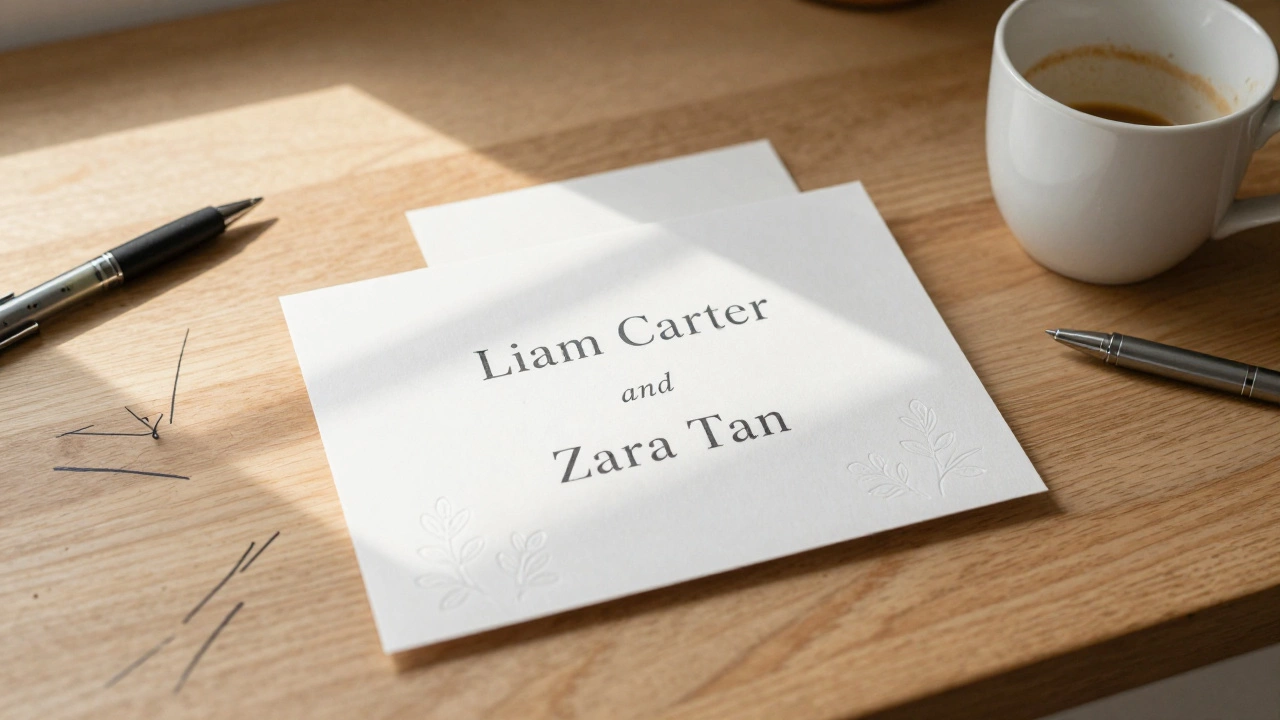
- Alphabetical: "Liam Carter and Zara Tan invite you to share in their joy as they begin their life together."
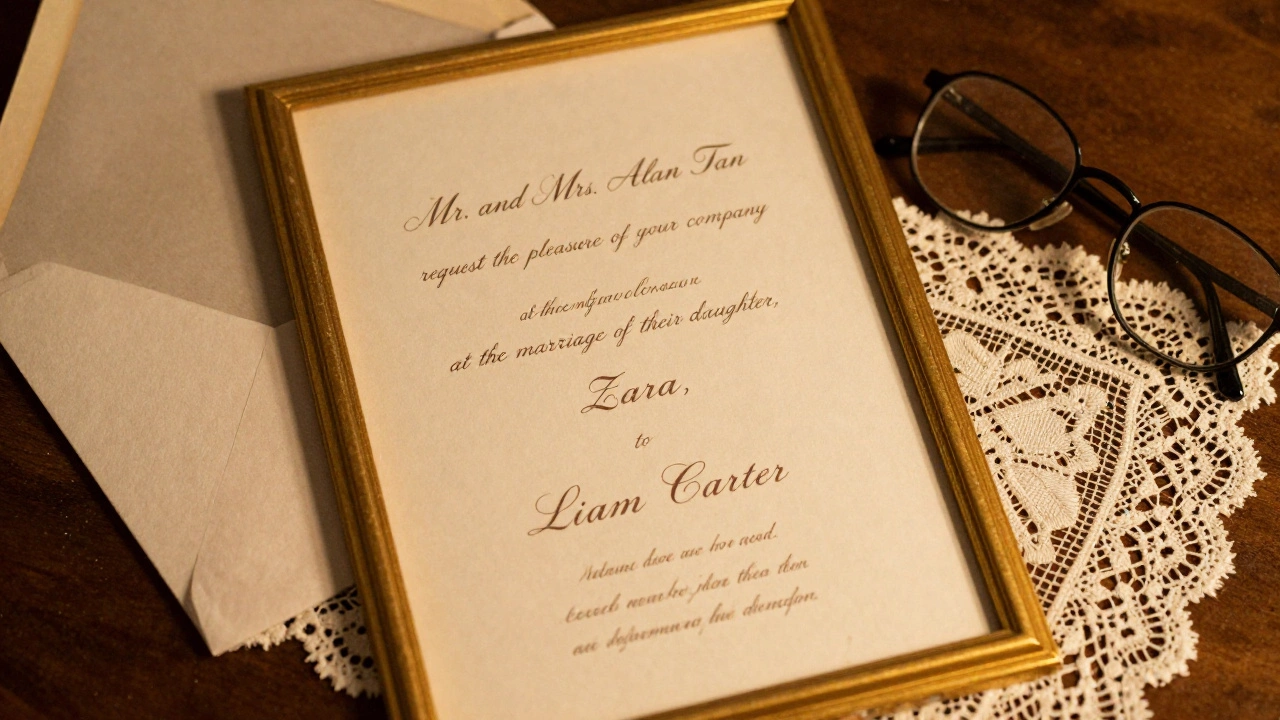
- Traditional (bride’s parents hosting): "Mr. and Mrs. Alan Tan request the pleasure of your company at the marriage of their daughter, Zara, to Liam Carter."
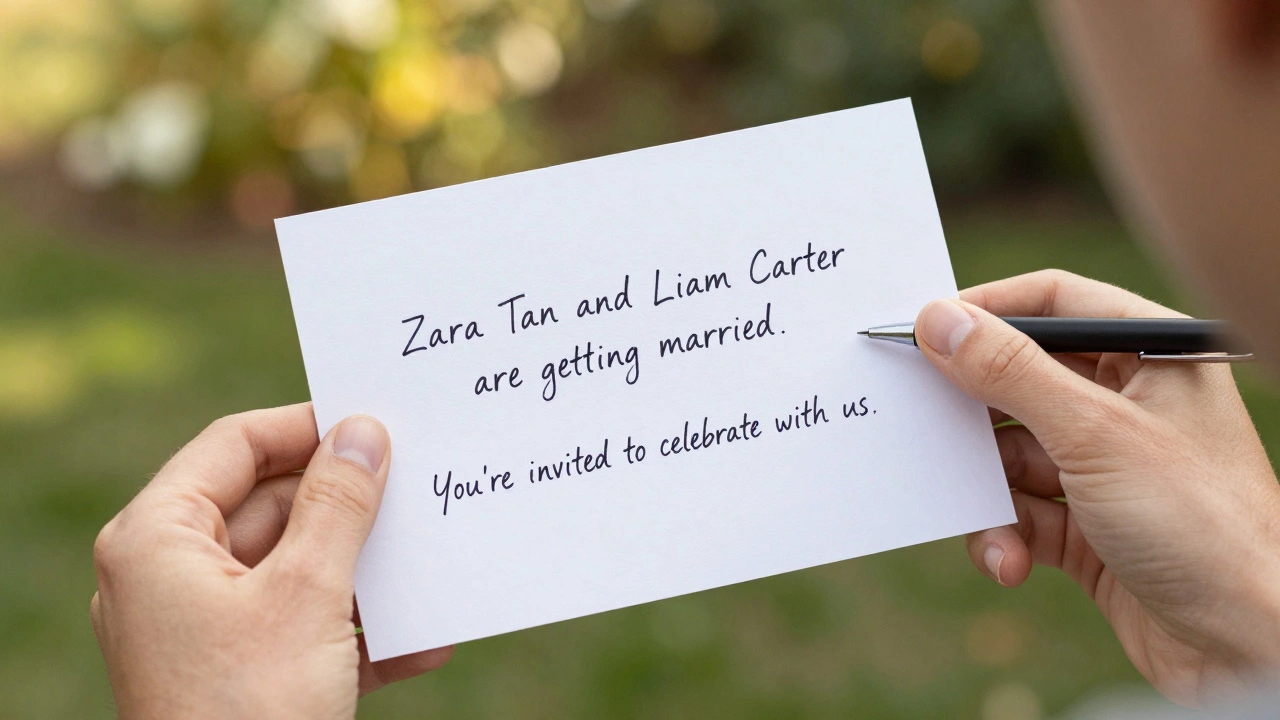
- Self-hosted, equal partnership: "Zara Tan and Liam Carter are getting married. You’re invited to celebrate with us."
Each one is correct. Each one reflects the couple’s values.
What to Avoid
Some outdated phrases still pop up-and they can cause awkwardness:
- "The honour of your presence is requested" - sounds like a royal decree. Too formal for most modern weddings.
- "Daughter of Mr. and Mrs. X" - unless you’re going for a 1950s theme, skip this. It reduces a person to their parentage.
- "Bride and groom" - unless you’re using those labels, don’t use them on the invite. Just use names.
Also, never put "and" before the groom’s name if you’re using traditional format. "Emily and James" is fine. But "Emily, daughter of Mr. and Mrs. Smith, and James Wilson"? That’s clunky and outdated.
What About Titles and Middle Names?
Full names on invitations? Only if they’re part of your identity. If you go by "Sam" but your legal name is Samuel, use "Sam." If your partner is "Dr. James Rivera," include the title only if it matters to you.
Most couples today skip titles unless they’re part of a family tradition. No need for "The Honourable" or "Reverend" unless you’re a judge or a priest getting married.
And middle names? Save them for the RSVP card or the seating chart. On the invitation, keep it clean: first and last names only.
Final Tip: Test It Out Loud
Read your invitation out loud. Does it sound like you? Does it feel right? If it makes you smile, you’ve got it.
Wedding invitations aren’t legal documents. They’re the first gift you give your guests-the promise of what’s to come. The order of your names is just one part of that story.
So choose the version that feels true. Whether it’s alphabetical, traditional, or something you made up yourself-it’s yours.
Does the bride’s name always go first on a wedding invitation?
No. While traditional invitations placed the bride’s name first, modern etiquette allows for alphabetical order, equal partnership, or whoever is hosting. The bride’s name doesn’t have to come first unless you’re following a specific family tradition or if her parents are hosting.
What if both sets of parents are hosting?
List both sets of parents together on the invitation. For example: "Mr. and Mrs. David Thompson and Mr. and Mrs. Robert Nguyen invite you to celebrate the marriage of their children, Sophie Thompson and Michael Nguyen." You can list them in the order of who you feel is more central to the event, or alphabetically by last name.
Should I include titles like "Dr." or "Reverend" on the invitation?
Only if the title is part of your everyday identity. Most couples skip titles on invitations unless they’re part of a formal family tradition. For example, if you’re a doctor and you use "Dr." in your professional life, it’s fine to include it. But don’t add titles just because someone has them-it can feel overly formal.
Is it okay to use "and" between our names on the invitation?
Yes, absolutely. "Anna Chen and Liam Rodriguez" is clean, modern, and widely accepted. Avoid outdated phrases like "the daughter of Mr. and Mrs. X and the son of Mr. and Mrs. Y." Keep it simple and personal.
What’s the best way to handle same-sex wedding invitations?
There are no rules. Use alphabetical order, the order you prefer, or who asked first. The goal is to reflect your relationship authentically. Many same-sex couples choose alphabetical order because it’s fair and neutral. Others choose the name that comes first in their daily life. There’s no wrong way-only what feels right to you.